
2026 World Cup Trionda: Wireless Power's Breakout Moment
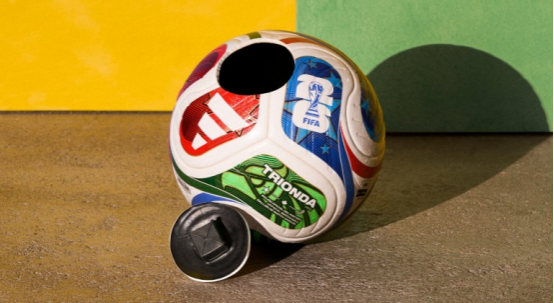
The 2026 US-Canada-Mexico World Cup has ignited, and beyond the spectacular goals, the "black technology" on the pitch is equally eye-catching. The official match ball "Trionda" (meaning "Triple Wave"), developed by Adidas, has embedded inside it a 500Hz Inertial Measurement Unit (IMU) chip weighing only about 14 grams—a three-axis gyroscope + accelerometer + UWB ultra-wideband transmitter that collects motion data 500 times per second and synchronizes it in real time to the VAR video assistant referee system, providing millisecond-level precision for Semi-Automated Offside Technology (SAOT) and handball decisions.
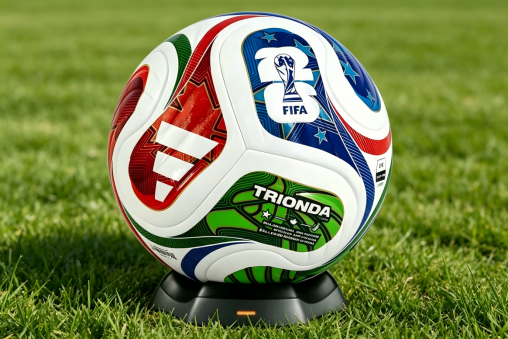
The energy source that keeps this sensing system running is wireless charging technology: before the match, the ball is placed on a dedicated charging dock, and after about 90 minutes of inductive wireless charging, it can run for approximately 6 hours, covering the entire match and the pre-match warm-up.
This is not a gimmick. Wired interfaces simply don't work in football scenarios involving high-intensity impacts, rolling, and waterproofing—wireless charging is the only solution.
I. Why Must Trionda Be "Wireless"?
Trionda is not just a football; it is a precision electronic instrument. Inside it is embedded a 500Hz Inertial Measurement Unit (IMU) chip weighing only about 14 grams (three-axis gyroscope + accelerometer + UWB), collecting motion data 500 times per second, providing millisecond-level basis for Semi-Automated Offside (SAOT).
To ensure the stable beating of this "electronic heart," wireless charging has become the optimal solution:
· Fully sealed structure, impervious to wind and rain: The football needs to roll through rain matches and muddy grass. Wireless charging eliminates physical interfaces, achieving IP67-level or above fully sealed waterproof and dustproof protection, completely eliminating short-circuit risks.
· Contactless, durable, and rugged: Facing high-intensity impacts and friction, wireless charging requires no plugging or unplugging, has no exposed metal contacts, and avoids wear, deformation, or electrical leakage.
· Rapid match preparation: Pre-match warm-up allows for charge-as-you-place, with 90 minutes of charging covering the entire match, requiring no manual maintenance.
II. Wireless Charging "Breaking Out": From Phone Accessory to Core Infrastructure for Sports Equipment
The wireless charging solution for the World Cup match ball sends a strong industry signal:
Wireless power technology is moving from a "nice-to-have" in consumer electronics to a "must-have" critical infrastructure across industries.
When a technology can withstand hundred-kilogram-level impacts, all-weather waterproofing, and zero exposed interfaces inside a football watched by billions of people worldwide, its reliability in industrial, transportation, logistics, and other scenarios becomes self-evident.
And this is precisely the battlefield where domestic wireless power core technology manufacturers like Zone Charge have been quietly laying the groundwork for over a decade.
III. From the Green Pitch to the Industrial Site: Continuous Expansion of Application Boundaries
Although Trionda's wireless charging solution is impressive, in the view of Zone Charge, the core principle of wireless power transmission is consistent, and its advantages of being non-contact, safe, and convenient are universal.
As one of China's earliest national-level specialized and sophisticated "Little Giant" enterprises focused on wireless power technology, we have not stopped at consumer electronics or small smart hardware. Over the past decade and more, Zone Charge has continuously pushed technological boundaries, committed to extending wireless charging application scenarios toward higher power, greater freedom, and higher safety and stability, solving real pain points in the industrial sector.
We have successfully transformed technology solutions originally used for small devices into mature industrial-grade applications, and have achieved mass production and stable shipments.
IV. Zone Charge's Core Battlefield: Empowering "Mobile Robots" Across Industries
Just as the Trionda football broke free from interface constraints through wireless charging, Zone Charge is enabling various mobile robots and industrial vehicles to achieve safe, seamless energy replenishment in more complex scenarios. Our solutions have formed scalable application advantages in the following areas:
| Application Scenario | Solution Advantages | Core Value |
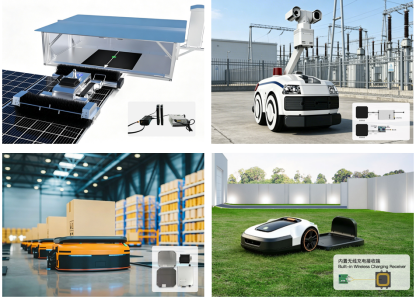
| Yard Robots (Pool Cleaning / Lawn Mowing / Snow Removal) | All-weather outdoor power supply | Solves outdoor waterproof and dustproof challenges, eliminates manual plugging/unplugging, adapts to complex yard terrain, and truly achieves unattended operation. |
| Industrial Handling Robots (AGV / RGV / AMR) | Continuous operation / dynamic power supply | Replaces sliding contact lines / battery swapping, supports high-current fast charging, eliminates cable wear, and improves logistics and warehousing turnover efficiency. |
| Special Inspection Robots (Robot Dogs / Inspection Carts / Unmanned Vehicles) | Highly reliable and safe power supply | Meets explosion-proof and dustproof requirements, providing stable and reliable energy assurance in high-risk scenarios such as mines and power utility tunnels. |
| Commercial Service Robots | Ultimate space utilization | Ultra-thin transmitter design, suitable for disinfection and delivery robots, enhancing equipment integration aesthetics and user experience. |
V. Hardcore Technology Foundation: Supporting Large-Scale Commercial Deployment
The ability to achieve mass shipments in the above scenarios stems from Zone Charge's deep accumulation in core underlying technologies:
· Magnetic resonance core technology: Mastery of magnetic coupling resonance technology, with power coverage up to 40kW and efficiency as high as 86%~94%, far exceeding industry standards.
· Adaptive control algorithms: Overcame the impact of charging distance and load variations on system performance. Whether robots are traveling over bumpy terrain or using different battery types, precise and stable power supply is maintained.
· Safety assurance: Equipped with high-precision FOD (Foreign Object Detection) capable of detecting coin-sized metal, meeting GB8702-2014 electromagnetic radiation safety standards, ensuring safety in human-machine coexistence environments.
The World Cup's Revelation: The Next Decade of Wireless Charging
The image of the 2026 World Cup match ball Trionda "charging before kickoff" is, in a sense, a wireless charging science popularization advertisement for society at large—it intuitively proves that:
· Wireless charging ≠ a small coil on the back of a phone; it can be the lifeline of a precision sensing system.
· The advantages of non-contact power supply in waterproofing, vibration resistance, and maintenance-free operation are unmatched by traditional interface solutions.
· Once standardization and scale are in place, the penetration speed of this technology will far exceed expectations.
For companies like Zone Charge that are rooted in underlying magnetic resonance technology, hold hundreds of patents, and have gone through seventeen years of R&D cycles, the World Cup spotlight happens to illuminate a larger trend: wireless power is transforming from a "technology highlight" into an "industry foundation."
And what Zone Charge is doing is replicating this ultimate convenience and safety into broader, more hardcore application scenarios.
Letting mobile robots run as freely as a football—we've always been on the road.