
ZoneCharge’s Back + Foot Wireless Charging for Humanoid Robots
As humanoid robots move from industrial production lines to home services, the last mile of autonomy is stuck at energy supply—only when charging no longer requires the act of plugging and unplugging can robots truly evolve from tools into intelligent agents. To address this pain point, ZoneCharge has launched wireless charging solutions with dual layouts: back and foot. Neither solution is superior to the other; they are targeted choices based on different scenarios and robot forms—the foot solution pursues “seamless integration,” while the back solution pursues “optimal performance.”
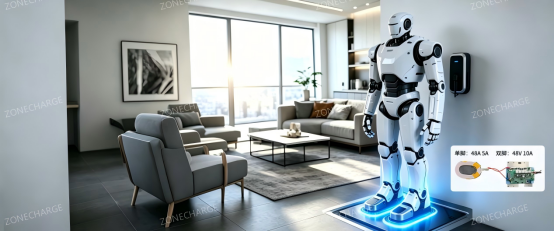
I. Foot Wireless Charging Solution: Charge While Standing
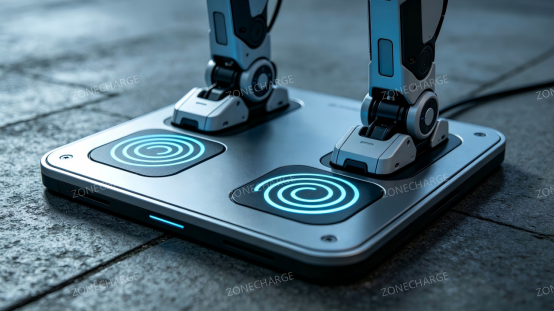
The foot solution embeds the wireless charging receiver module into the robot’s feet, while the transmitter is designed as a ground-embedded charging post or charging pad. The robot only needs to walk to the designated area and stand with both feet on the charging zone to automatically start charging, with no plugging or unplugging throughout the process.
Based on magnetic resonance technology, the charging distance is about 5 cm, allowing a certain offset between the transmitter and receiver, so the robot does not require millimeter-level precise positioning. The robot can autonomously decide to go to the nearest wireless charging point based on its battery status, achieving “charge as soon as it stops, leave as soon as it is full.”
Core advantages of the foot solution:
Weight at the very bottom actually helps stability. Adding the receiver module’s weight to the soles pushes mass below the system’s center of gravity, objectively lowering the overall center of mass. Compared with the “disruptive weight gain” of back mounting, foot weight gain is constructive—it helps the robot stand more stably.
Zero interference with charging posture: “rest your feet and charge.” The back solution requires the robot to perform extra posture alignment actions (backing against a wall or aligning with a pillar), involving full-body coordinate transformation. The foot solution, by contrast, relies on what humanoid robots do best—standing. Walk to the charging area, place both feet down, pressure sensors confirm positioning, and charging starts automatically; the whole process almost overlaps with the normal standby posture.
Relieves battery capacity requirements and creates a positive cycle of overall weight reduction. Because the robot can perform fragmented “opportunity charging” between tasks (brief charging stops while waiting for commands or passing supply points), it does not need to carry a huge battery pack “to last all day” everywhere. Battery capacity can be appropriately reduced → overall weight decreases → energy consumption per step drops → range actually increases.
No exposed electrodes + ground deployment, adapting to complex and harsh environments. The soles face the ground and have no exposed metal contacts, naturally eliminating arcs, sparks, and oxidative corrosion caused by plugging and unplugging, making them safer in humid workshops, dusty environments, and even explosion-proof sensitive areas. Embedding the transmitter in the ground also means charging facilities do not occupy facade space.
Minimal modification to the robot body. The receiver is concentrated in the feet—an area that is already a structural component, load-bearing part, and cable routing channel—so there is no need to change the torso skeleton topology, modify the back shell mold, or readjust the overall center-of-mass model, making the integration path the shortest.
The foot solution is suitable for industrial manufacturing and warehousing logistics scenarios, where robots “rest and recharge” during gaps in frequent movement without interfering with motion posture.
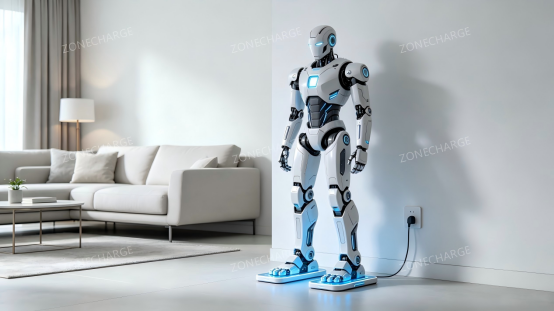
II. Back Wireless Charging Solution: Embrace-Style Recharging, Unleashing Limb Freedom
The back solution installs the wireless charging receiver module near the center of gravity on the robot’s back, enabling “embrace-style” charging through wall-mounted or pillar-mounted transmitter panels.
Core advantages of the back solution:
Optimized motion balance without raising the center of gravity. The receiver is located near the torso’s center of gravity, concentrating weight in the robot’s most stable core area, minimizing impact on motion balance. Unlike the foot solution, which “lowers the center of gravity,” the back solution starts from the center of gravity, ensuring the added weight itself does not disrupt the original dynamics model.
Unleashes limb freedom. This is the most unique value of the back solution—with the receiver on the back, the robot’s hands and feet are completely free from the constraints of the charging mechanism. For high-end service robots that frequently use their arms for manipulation, grasping, and interaction, complete freedom of the limbs is crucial.
Flexible charging posture and high space utilization. Installing transmitter panels on walls or pillars does not occupy floor space. In homes, showrooms, offices, and other scenarios where floor space is precious or unsuitable for ground equipment, the back solution’s facade deployment is more advantageous.
The back solution is suitable for high-end service robot scenarios, such as home services, reception and guidance, and exhibition hall interpretation, where robots’ upper-limb manipulation capability and spatial adaptability are more demanding.
III. How to Choose Between the Two Solutions?
| Comparison Dimension | Foot Solution | Back Solution |
| Receiver Position | Inside the feet | Near the center of gravity on the back |
| Transmitter Deployment | Ground-embedded | Wall-/pillar-mounted |
| Charging Posture | Standing (natural standby posture) | Backing against a wall / aligning with a pillar |
| Center-of-Gravity Impact | Lowers the center of gravity, helping stability | Stays near the center of gravity, without disturbing balance |
| Limb Freedom | No impact | Fully unleashed |
| Application Scenarios | Industrial manufacturing, warehousing and logistics | High-end services, homes, showrooms |
| Core Value | Seamless integration into the workflow | Optimal performance, liberated limbs |
Choose the foot solution if the robot moves frequently on industrial production lines or in warehouses, charging needs to fit into the rhythm of normal walking and stopping, ground space is abundant, and you are sensitive to modification difficulty and cost.
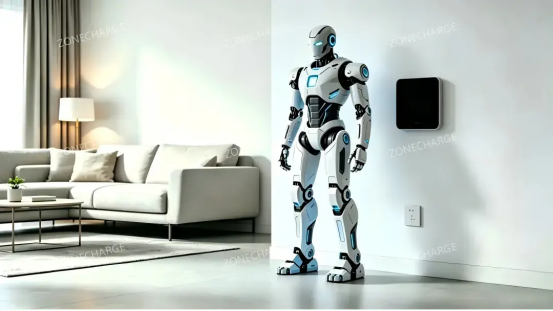
Choose the back solution if the robot needs to frequently use its upper limbs for grasping, manipulation, and interaction, requires high limb freedom, and the deployment environment is better suited to facade installation (such as homes, showrooms, and office spaces).
Technological evolution is never a single-dimensional replacement, but multi-dimensional adaptation. The back solution excels in maturity and stability, serving as a reliable guarantee for static operations; the foot solution excels in engineering ingenuity, serving as the optimal solution for dynamic mobile scenarios.
Through its “back charging + foot charging” dual-track strategy, ZoneCharge provides a full-scenario wireless power ecosystem for the humanoid robot industry. When robots—whether “leaning and resting” at their workstations or “stopping to rest” in aisles—can silently complete energy replenishment, the era of true autonomy for humanoid robots will be within reach.