
New Standard Raises Wired Charging Costs, Opens Wireless Window
On March 31, 2026, the State Administration for Market Regulation and the Standardization Administration of China officially issued mandatory national standard GB 47371-2026, Safety Technical Specifications for Electric Bicycle Charging Piles, which will be fully implemented starting April 1, 2027.
This is another major national standard in the field of electric bicycle charging following GB 42296-2022, Safety Technical Requirements for Chargers for Electric Bicycles. It marks that electric bicycle charging facilities have officially entered an era of strong regulation in which "there are standards to follow and violations will be prosecuted."
However, for the vast number of charging facility operators, property managers, and electric bicycle users, the new national standard brings not only "compliance pressure," but also an opportunity to re-examine charging solutions. As the cost of wired charging is continually pushed up by national standards, the replacement value of wireless charging is being released at an accelerating pace.
How Strict Is the New National Standard? The "Escalating" Costs of Wired Charging
GB 47371-2026 sets out comprehensive, full-life-cycle mandatory safety requirements for electric bicycle charging piles:
In terms of electrical safety, charging piles must have short-circuit protection, overcurrent protection, overvoltage protection, leakage protection, and overtemperature protection. Each item must undergo rigorous testing. If any link fails to meet the standard, the product may not be marketed.
In terms of functions and O&M, automatic power-off under no load, automatic stop when fully charged, real-time fault alarms, and remote monitoring—functions that used to be merely "bonus items"—have now become "mandatory items."
In terms of materials and environment, fire retardancy, lightning protection, and environmental adaptability—from casing materials to internal circuits, every component must comply with safety standards.
In short: for a compliant wired charging pile, costs are rising in every link, from design, component selection, and production to installation and O&M. For charging pile manufacturers, existing low-end product lines may face complete phaseout. For operators, the replacement and upgrading of old equipment also represents a considerable investment.
An Overlooked Fact: Wireless Charging Is Not on the "Prohibition List"
It is worth noting that this is not the first time national standards have imposed strict rules on charging safety. As early as GB 42296-2022, the state had already made clear:
Clause 4.3: The design, manufacture, and use of vehicle-mounted chargers are prohibited.
Clauses 5.5.6–5.5.8 (Output Interface Safety): "Not applicable to wireless chargers."
The logic here is very clear: the physical interface of wired charging is the root cause of safety hazards—plugging/unplugging wear, contact oxidation, water ingress short circuits, vibration loosening... Therefore, the standard cuts off the hazards by "strictly prohibiting vehicle-mounted chargers." Because wireless charging has no physical contact interface, it naturally avoids all the above risks and is therefore explicitly excluded from the scope of restrictions.
This is equivalent to saying: the state's attitude toward the two charging modes is already very clear—wired charging must be "strictly regulated," while wireless charging can be "exempted."
When the New National Standard Meets a Huge Market: Why Is Now the Best Time to Enter Wireless Charging?
Opportunity One: The Window for Wired Retrofitting—A 12-Month Countdown
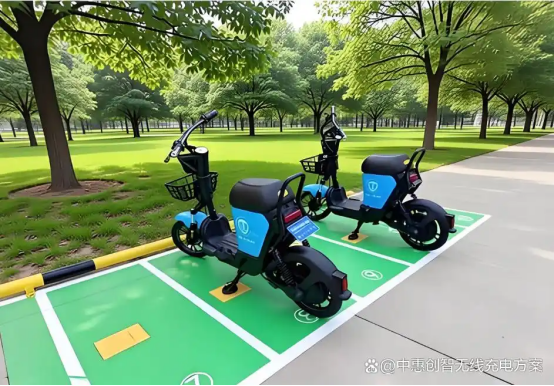
GB 47371-2026 sets a transition period of about 12 months. By April 1, 2027, all charging piles on sale must comply. This means that this year a large number of charging pile facilities will face upgrading and replacement. For property management, communities, and industrial parks, rather than spending money to upgrade old equipment and continue down the "old wired path," it is better to choose a wireless charging solution in one step.
Opportunity Two: Safety Value Is Being Reassessed
The number of electric bicycles in use has exceeded 400 million, but more than 20,000 fire accidents are caused by charging every year. The root reason for the continuous tightening of the new national standard is that the safety hazards of traditional charging methods are structural. Wireless charging, through "zero contact, zero plugging/unplugging, and zero leakage," physically eliminates the biggest pain point of charging safety.
Zero contact: no plugging/unplugging action, no interface wear.
Zero plugging/unplugging: charge upon parking, auto-stop when full; there is no risk of "forgetting to unplug the charger."
Zero leakage: fully enclosed insulation design, IP67 waterproof and dustproof, resistant to rain and water immersion.
Opportunity Three: The Industry Reshuffling Period Is the Entry Period
While some companies are still struggling with "how to get old products certified under the new national standard," Zone Charge's wireless charging solution has already been implemented. The stricter the standard, the greater the relative advantage of wireless.
Zone Charge: A Wireless Charging Solution Already Prepared
As a national-level specialized and sophisticated "little giant" enterprise, Zone Charge has taken the lead in achieving technology implementation and large-scale deployment in the field of wireless charging for e-bikes:
International Standards Certification: It adopts coupled magnetic resonance wireless power supply technology. The system has passed full-item testing under GB 42296-2022, is IP67 waterproof and dustproof, and has triple protection against overvoltage/overcurrent/overtemperature, with charging efficiency of 83%–95%.
Full Scenario Coverage
Community scenarios: wall-mounted/floor-standing wireless charging piles, direct 220V access, traceless installation.
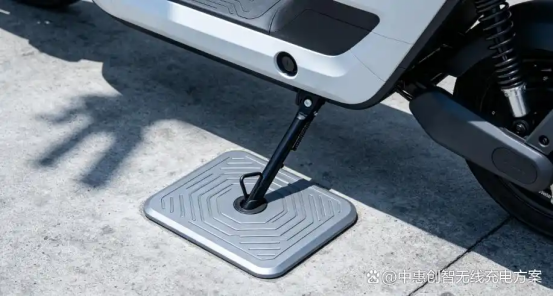
Public stations: ground-embedded transmitters, "charge as soon as the kickstand is down"; a single control cabinet can connect 10 transmitter piles.
Cooperation with vehicle manufacturers: vehicle-integrated receivers to achieve "seamless charging."
Scale Validation: Mass production at dual bases in Shenzhen and Fuyang, with annual capacity exceeding one million units, and it has served more than 400 industry scenarios.
Conclusion
From GB 42296-2022 to GB 47371-2026, standards are upgrading and the safety baseline is rising. Every tightening of standards is a "survival of the fittest" for the industry.
For wired charging, compliance is a cost; for wireless charging, compliance is an opportunity.
As the cost of wired solutions keeps climbing amid "escalating requirements," and as national standards are opening policy channels for wireless charging—this hundred-billion-level electric bicycle charging market is ushering in a true "charging mode revolution."
Zone Charge is ready.